
Why Buyers Buy (Or Don't)
Updated: Sep 20
By Michael Nash, Founder of Sage Sales Consulting

Why Buyers Buy (Or Don’t): The Truth Most Sellers Avoid
Let’s start with an uncomfortable truth:
Buyers don’t struggle because they lack options.They struggle because they don’t trust them. Today's B2B buyer is operating in one of the most difficult decision environments in modern business history. They face relentless pressure, compressed timelines, and a marketplace flooded with endless solutions—all claiming transformational outcomes. Many have also been burned before by bold promises that never delivered.
This isn’t just difficult. It’s dangerous.
These decisions often determine careers.
Imagine the Chief Security Officer responsible for protecting the enterprise from an expanding universe of cyber threats. Or the EVP of Supply Chain Operations whose decisions determine whether products ship, revenue flows, and customers remain satisfied. When they choose wrong, consequences are immediate and visible.
Yet sellers continue to show up with more pitches, more features, and more noise.
And then we wonder why deals stall.
After studying thousands of opportunities, a few undeniable truths explain why buyers buy or why they walk away.
Truth #1: Trust Is the Only Currency That Matters
Features don’t close deals.Pricing doesn’t close deals.Presentations don’t close deals.
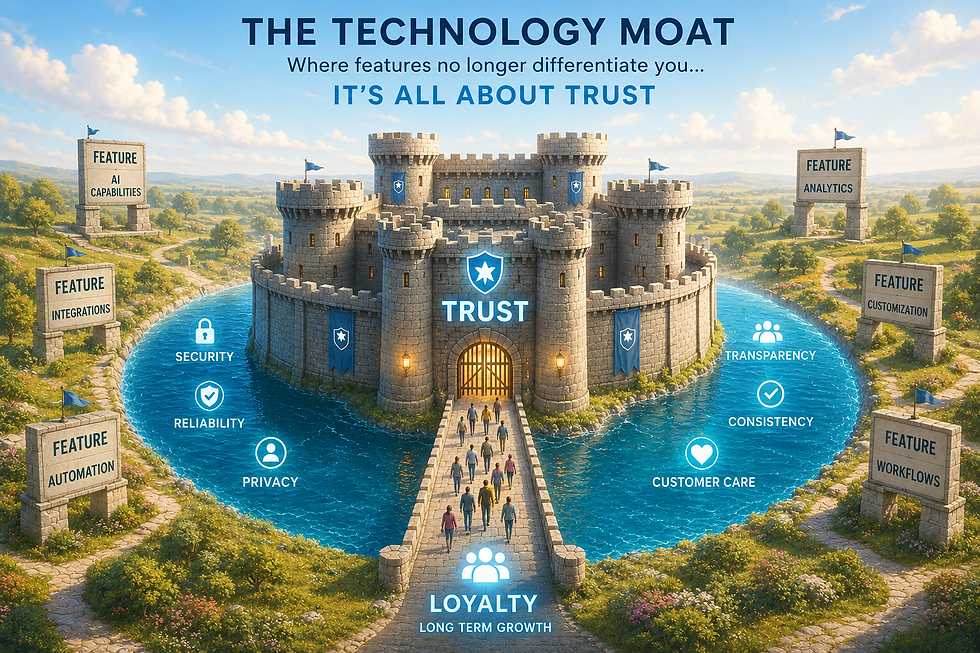
Trust closes deals. When trust exists, buyers move forward—even in uncertainty.When trust is absent, nothing else matters. Without trust, sellers don’t lose to competitors.They lose to inaction.
Truth #2: More Choice Doesn’t Create Clarity — It Creates Fear
The modern marketplace doesn’t empower buyers. It overwhelms them.
AI-generated messaging, look-alike solutions, and identical claims of differentiation have created a sea of sameness. Every vendor promises transformation. Every platform claims leadership. Every solution sounds essential.
Buyers are left asking:
Who actually delivers value?
Who shows up when things go wrong?
Who is real—and who is, as they say in Texas, “all hat, no cattle”?
This confusion isn’t accidental. It’s the predictable outcome of a market obsessed with promotion over proof.
Truth #3: Confused Buyers Do Two Things — Both Bad for Sellers
They freeze. Confusion creates decision paralysis. Deals stall. Opportunities slip into “closed/no decision.” Forecasts collapse. Revenue disappears. And sellers waste months chasing outcomes that were never real. The hidden cost is staggering: time spent on unwinnable deals instead of investing in opportunities where real value could be created.
Or they commoditize. When buyers can’t see meaningful differences, everything looks the same. The decision defaults to price. The conversation becomes transactional. The result is the inevitable race to the bottom. This isn’t buyer behavior. It is a failure of seller differentiation.
The Hard Reality for Sellers
Selling today is harder than ever—not because buyers are difficult, but because trust is scarce.
We face buyers who:
Assume risk before value
Default to skepticism
Choose safety over change
Treat solutions as interchangeable
But no great seller wants to be a commodity. No organization aspires to win by being cheaper. Real professionals want conviction in the value they deliver and the ability to help customers achieve outcomes others cannot.
That requires a fundamentally different approach to engagement.
Selling the Sage Way: The Shift from Vendor to Trusted Advisor
Selling the Sage Way exists because traditional selling no longer works.
It is an engagement framework built on a simple belief:
Buyers don’t need more persuasion. They need more certainty.
The framework helps you:
Build deep trust through authentic engagement
Create psychological safety for the buyer
Provide true buyer agency
Reduce the perceived risk of change
Clarify value in a world of noise
In today’s market, your product is not your greatest differentiator.
Your presence is.Your credibility is.Your ability to create trust is.
How you show up matters more than what you sell. When practiced consistently, Selling the Sage Way transforms your role from transactional vendor to Trusted Advisor. This is the highest form of commercial relationship and the opposite of the tactical, feature-driven selling that dominates most organizations today.
Trusted Advisorship is not a tactic. It is a position of earned influence.
If Trusted Advisorship is your North Star, Selling the Sage Way is the compass that gets you there.


Comments