
The New (Old) Moat in the AI Era
Updated: Sep 20
By Mchael Nash, Founder of Sage Sales Consulting
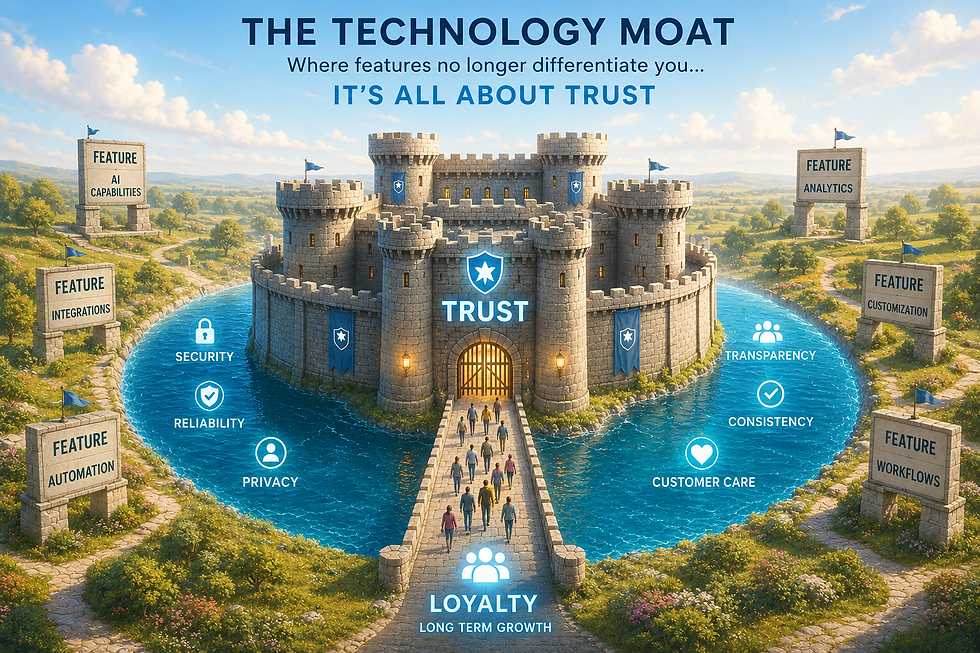
Why Features No Longer Matter
Since the early 1990s, the playbook for building a massive software company was simple, albeit incredibly difficult: build a better product with more features.
Industry titans like SAP, Oracle, Microsoft, Salesforce, and Adobe built category-defining empires on this exact model. They raised massive capital, hired elite software engineers, and developed complex platforms. Because this process was so expensive and resource-intensive, competition stayed small. It was a primitive form of market capture. Very few could summon the resources to build a durable software business and those who did, won big.
But those days are firmly in the rearview mirror.
Welcome to the "Sea of Sameness"
We are now living in a fully realized AI era, where "vibe coding" and automated development platforms have obliterated the product feature moat. What used to take a competitor one to two years to catch up on can now be cloned over a single weekend. Thanks to the democratization of AI engineering at a massive scale, the technical playing field has been completely leveled.
If you are an AI software or services company, this forces a critical question: What is your strategy for creating a durable moat? How do you build a lasting competitive advantage when your product capabilities are now just table stakes?
While there are a few ways to answer this, the most critical shift is happening right now: Brand is coming back to the forefront.
The Ultimate Differentiator: Trust
In a world where everyone can build everything, your corporate and personal brand must become your ultimate competitive differentiators.
But what does your brand actually stand for? Innovation? Scale? Reliability? While those attributes are important, none of them matter without the foundation of everything: Trust.
Is your brand trustworthy? Do potential customers actually believe in your word, your integrity, and your character?
We live in an untrustworthy digital environment. AI has created what I call a "sea of sameness." Buyers are overwhelmed. They don't trust sellers because AI has generated too many choices that all sound exactly the same.
This creates confusion, which quickly spirals into commodity thinking. When faced with a sea of identical-sounding options, buyers typically do one of two things:
They do nothing (the dreaded "no decision").
They buy the lowest-cost option, which inevitably fails to deliver and carries massive hidden costs.
Going Back to Go Forward
This is a massive wake-up call for the tech industry. We are going back in time to an era when trust was the currency that mattered most, when a person’s word was their ultimate reputation.
To survive and thrive in this new landscape, software and AI leaders must embrace a fundamental shift in mindset:
How you sell and engage is now infinitely more important than what you sell.
Moving forward, the winners won't be the companies with the longest feature list. The winners will be those who know how to elevate themselves from a tactical vendor to a strategic partner.
At Selling the Sage Way, we’ve spent years training tech teams on this exact philosophy. It’s a counterintuitive approach to modern business, but in an AI-saturated market, it is the only way to unlock durable, long-term value for both you and your customers.
The feature war is over. The trust war has begun.
What steps is your team taking to build trust in a market flooded with AI clones?


Comments